
Working From Home Tax Deduction: The 70c Fixed Rate Method Explained
By Easha · Tax accountant, Sydney
The fixed rate method lets you claim 70 cents for every hour you work from home — no need to add up every bill. What the 70 cents covers, what you can claim on top, the records you need, and worked examples.
Key takeaways
- The fixed rate method lets you claim 70 cents for every hour you work from home. The ATO’s published rate is 70 cents for the 2024–25 and 2025–26 income years — it has not published a separate rate for 2026–27 yet, so 70 cents remains the rate in force for now.
- The 70 cents covers your internet, phone, electricity, gas, stationery and computer consumables in one bundle. You cannot claim those expenses separately on top of the fixed rate.
- You can claim extra for the decline in value of your home-office furniture and technology — and items costing $300 or less can be claimed in full in the year you buy them.
- You must keep a record of your actual hours worked from home for the whole year. An estimate of your hours will not be accepted.
- The alternative is the actual cost method: working out the work share of your real bills. It takes more records, but it can pay better if your running costs are high.
If you work from home — even just a day or two a week — the extra power, internet and phone use is a real cost, and the tax system lets you claim it. The simplest way is the ATO’s fixed rate method: count your hours, multiply by 70 cents, and you are done. No adding up bills, no working out percentages.
This guide explains what the 70 cents covers, what you can still claim on top, the records the ATO expects, and how the fixed rate compares with claiming your actual costs.
This is general information, not tax or financial advice. The figures come from the ATO page linked below — check it, or speak to a registered tax agent, for your own circumstances.
What the 70 cents covers
The fixed rate is a bundle. Each hour you work from home covers the additional running expenses of:
| Covered by the 70c rate | What it means |
|---|---|
| Home and mobile internet or data | The extra data you use while working |
| Mobile and home phone usage | Work calls on your personal phone |
| Electricity and gas | Heating, cooling and lighting your workspace |
| Stationery and computer consumables | Printer ink, paper and similar items |
Because these are bundled into the rate, you cannot claim any of them separately as well. If you use the fixed rate method and then also claim your full internet bill, you are double-counting — and that is exactly the kind of thing the ATO checks.
You do not need a separate room to use the fixed rate method. Working at the kitchen table counts, as long as you incur additional running expenses because you are working from home.

You don’t need a dedicated home office to use the fixed rate — the kitchen table counts, as long as you incur extra running costs.
Worked examples: what is your deduction worth?
The calculation is simple: hours worked from home × 70 cents. Assuming 46 working weeks in the year (allowing for leave and public holidays) at 8 hours a day:
| Days at home per week | Hours per year | Fixed rate deduction |
|---|---|---|
| 1 day | 368 hours | $257.60 |
| 2 days | 736 hours | $515.20 |
| 3 days | 1,104 hours | $772.80 |
| 4 days | 1,472 hours | $1,030.40 |
| 5 days | 1,840 hours | $1,288.00 |
Two days a week from home is worth a $515.20 deduction. At a 30% marginal tax rate plus the 2% Medicare levy, that saves about $165 in tax. Five days a week is worth $1,288 — roughly $412 back at the same rate.
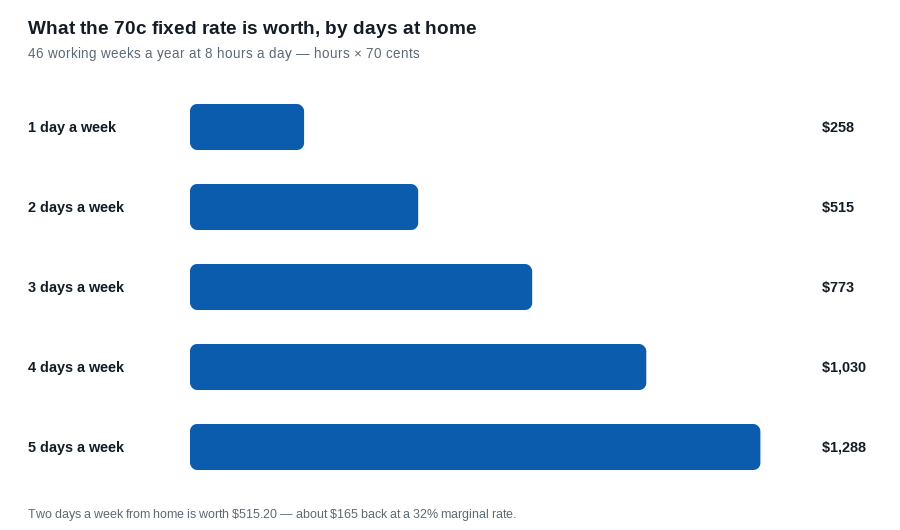
Every extra day at home adds 368 hours a year — worth $257.60 at the 70 cent rate.
The ATO’s own examples
Keisha is an engineer who worked from home for 843 hours in 2025–26, recorded in her timesheets. Her deduction is 843 × 70c = $590. She cannot also claim her mobile phone expenses separately — the fixed rate already includes them. If she wants to claim all her phone expenses, she would need to use the actual cost method instead.
Yang is a software engineer who started working from home 2 days a week in December 2025. He worked from home for 567 hours and kept a spreadsheet of his start and finish times. He also bought a desk for $250 and an office chair for $299, used only when working from home.
| Yang’s deduction | Amount |
|---|---|
| Fixed rate: 567 hours × 70c | $396.90 |
| Desk (under $300, work use only) | $250.00 |
| Office chair (under $300, work use only) | $299.00 |
| Total | $945.90 |
Yang claims $945 in his tax return — the cents are disregarded, not rounded. His desk and chair are claimable on top of the fixed rate because the rate does not cover furniture and equipment.
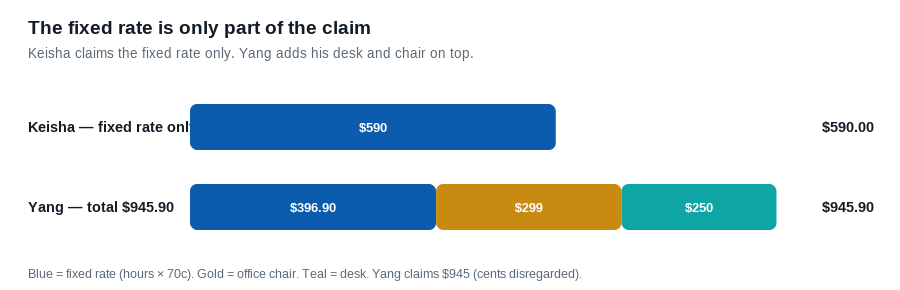
The fixed rate is only part of the story — furniture and equipment can add hundreds more on top.
How to work out your deduction: 5 steps
The ATO’s method, step by step:
- Work out your total hours. Add up the actual hours you worked from home during the income year, using records you kept at the time — a timesheet, roster, diary or similar document.
- Multiply by the rate. Hours × 70 cents (the rate for the 2025–26 income year).
- Add the decline in value of any depreciating assets you used to work from home, such as a computer, desk or chair.
- Add any other expenses the rate does not cover — for example, repairs to your home-office equipment.
- Add it all together. The total, with cents disregarded, is the amount you claim.
What you can claim on top of the fixed rate
The fixed rate covers running costs only. These are separate:
- Decline in value of technology and furniture. Computers, desks, chairs, bookshelves and similar items decline in value over their effective life, and you claim the work-related share each year.
- Items costing $300 or less. If an item costs $300 or less and you use it mainly for work, you can claim the full cost in the year you buy it — keyboards, computer mice, power boards, desk lamps and chargers, for example. You cannot put an item like this into a low-value pool as well.
- Repairs and maintenance of your home-office equipment.
- Occupancy expenses — only in limited circumstances. If you have a dedicated home office set aside solely for work, you may also be able to claim a share of mortgage interest or rent, and cleaning for that room. This is a narrower test than the fixed rate: a corner of the living room does not count.
Where you use an asset for both work and private purposes, you can only claim the work-related portion — so keep a record of how much of the time it is used for work.
The records you must keep
This is where claims fall over. To use the fixed rate method you must keep:
- A record of the actual hours you work from home for the entire income year — a timesheet, roster, diary or similar document kept at the time you work. An estimate of your hours will not be accepted.
- At least one record for each running expense the rate covers — for example, one quarterly electricity bill and one monthly internet bill.
- Records for depreciating assets showing what you spent and the percentage of work use, kept for 5 years from your last claim for decline in value.
Keep your records for 5 years from the date you lodge your tax return.
What happens if you estimate your hours
Wanda works from home one day a week. For the period 1 July 2025 to 28 February 2026 she kept her bills but no record of her hours, and later estimated 280 hours for that period. From 1 March 2026 she kept a record in her email calendar and worked from home for 136 hours.
Wanda can claim 136 × 70c = $95 for the period she has records for. She cannot claim anything for the 280 estimated hours — estimates are not accepted, and only a record kept at the time the hours are worked counts. The ATO’s myDeductions tool in the ATO app is a simple way to keep the record as you go.
One monthly internet bill and one quarterly power bill cover the expense records — but the hours must be recorded as you work them.
Fixed rate vs actual cost method
The fixed rate is simple, but it is not always the biggest deduction. The actual cost method means working out the work-related share of your real bills — your internet plan, your electricity, your phone — plus decline in value of equipment. It needs more records, including receipts and a reasonable basis for apportioning each bill.
| Fixed rate method | Actual cost method | |
|---|---|---|
| How it works | Hours × 70c | Work share of your actual bills |
| Records needed | Hours + one record per expense type | Hours + all bills + apportionment basis |
| Internet, phone, power | Bundled in the 70c — no separate claim | Claimed at their work share |
| Furniture and equipment | Claimed separately | Claimed separately |
| Best for | Most people; simple and fast | High running costs, e.g. a large home office or expensive internet plan |
If your bills are modest, the fixed rate usually wins on simplicity. If you run a large home office with high power and internet costs, it is worth doing the sums both ways — but you must choose one method for the year, and you cannot mix the two for the same expenses.
Working from home and the $1,000 standard deduction
From the 2026–27 income year, most employees can claim a flat $1,000 standard deduction instead of itemising work-related expenses — no receipts needed. Your working from home running costs can sit inside that $1,000: if your total work expenses are under $1,000, the standard deduction is the simpler choice. If they add up to more than $1,000 — for example, a full year working from home plus other work expenses — itemising, including your fixed rate claim, will be worth more.
Either way, do not count the same cost twice. A dollar of home-office running costs is either inside the $1,000 or itemised on top of it, never both.
FAQ
Can I claim the fixed rate if my employer pays for my internet? No — not for the part your employer pays. You can only claim expenses you actually incur. If your employer reimburses your internet or provides it, there is no additional running expense for you to claim.
Do I need a separate home office room? Not for the fixed rate method. You need to incur additional running expenses because you work from home, which can happen at the kitchen table. A separate, dedicated room only matters if you want to claim occupancy expenses such as rent or mortgage interest.
Can I claim both the fixed rate and my internet bill? No. The 70 cents already includes internet, phone, electricity, gas, stationery and computer consumables. Claiming any of those separately on top is double-counting.
What if I work from home some days and in the office others? Claim only the hours you actually work from home. Two days a week for 46 weeks is 736 hours, worth $515.20 at the fixed rate.
Is the rate still 70 cents for 2026–27? The ATO’s page currently lists 70 cents for the 2024–25 and 2025–26 income years and has not published a separate 2026–27 rate yet. Until it does, 70 cents is the rate in force — check the ATO page before you lodge your 2026–27 return.
Can I claim coffee or food while working from home? No. Food and drink are private expenses, not work-related deductions, even if you eat at your desk.
Sources
- ATO — Fixed rate method
- ATO — Working from home expenses
Calculate Your Exact Weekly Tax
Enter your pay details and instantly see your PAYG tax, Medicare levy, and take-home pay.
Open the Calculator