Crypto Tax Australia: How Bitcoin and Crypto Are Taxed in 2026–27
By Easha · Tax accountant, Sydney
Crypto is a CGT asset in Australia — selling, swapping or spending it is a disposal, and staking rewards are ordinary income. Here's how crypto tax works, with a worked $30,000 Bitcoin gain and the records the ATO expects.
Key takeaways
- Crypto is a CGT asset, not money or foreign currency. Selling it, swapping it for another crypto, spending it or gifting it is a disposal — a CGT event.
- You owe capital gains tax even if you never convert to Australian dollars and even if you use the proceeds to buy more crypto.
- Hold for 12 months or more and the 50% CGT discount halves the gain you add to your taxable income — for now. From 1 July 2027 the discount is replaced by cost base indexation plus a 30% minimum tax.
- Staking rewards and airdrops are ordinary income, declared at “Other income” in Australian dollars when you receive them.
- Moving crypto between your own wallets is not a disposal and does not need to be reported.
- Keep records of every transaction — date, Australian dollar amount, purpose, the other party and exchange receipts — for five years.
Crypto feels like money, but the ATO does not treat it that way. For tax purposes, a crypto asset is a capital gains tax (CGT) asset — closer to a share than to a dollar. That one fact drives almost everything else: when tax is triggered, how the gain is worked out, and what records you need.
This is general information, not tax or financial advice. The figures come from the ATO pages linked below — check them, or speak to a registered tax agent, for your own circumstances.
What counts as a disposal
You make a capital gain or loss when you dispose of a crypto asset. The ATO counts all of these as disposals:
- Selling crypto for Australian dollars or another fiat currency
- Swapping one crypto for another — exchanging ETH for SOL, for example
- Spending crypto on goods or services
- Gifting crypto to someone else
- Converting crypto to fiat, or depositing it into a liquidity pool, or wrapping it
Two common surprises catch people out. First, a swap is a disposal even though no cash changes hands. Swapping ETH for SOL triggers CGT on the ETH, even if you never touch a dollar. Second, you have a CGT obligation even if you use the proceeds to buy more crypto or never convert them to Australian dollars — the gain is real the moment you dispose of the asset.
One thing that is not a disposal: transferring crypto between wallets you own. Moving Bitcoin from an exchange to your own hardware wallet changes nothing for tax, as long as you keep ownership.
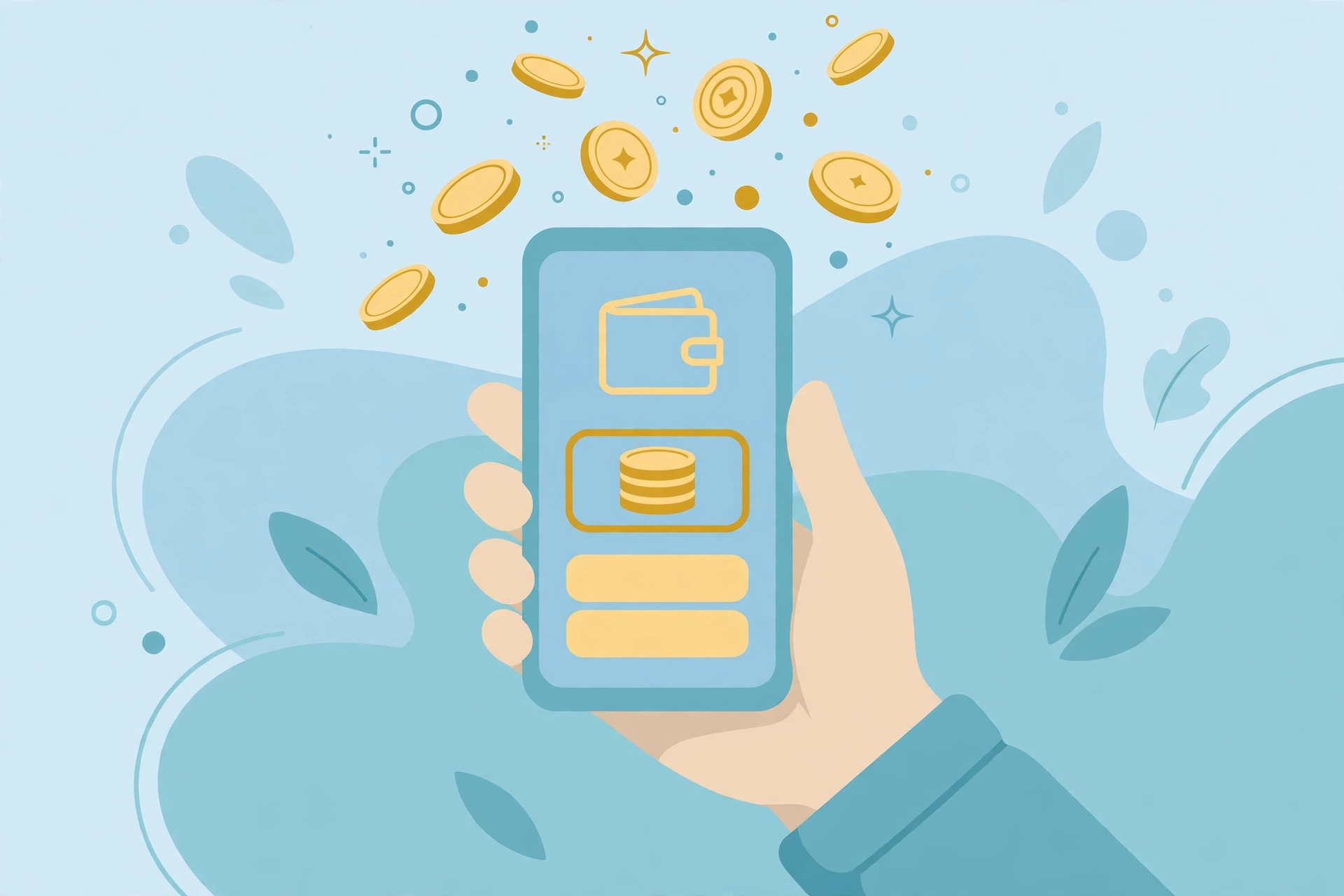
Selling, swapping, spending or gifting crypto is a disposal. Moving it between your own wallets is not.
Worked example: a $30,000 Bitcoin gain
Say you buy 1 Bitcoin for $50,000 and sell it 14 months later for $80,000.
| Step | Working | Amount |
|---|---|---|
| Capital proceeds (sale price) | $80,000 | |
| Cost base (what you paid, plus brokerage) | −$50,000 | |
| Capital gain | $80,000 − $50,000 | $30,000 |
| 50% CGT discount (held more than 12 months) | $30,000 × 50% | −$15,000 |
| Gain added to taxable income | $15,000 |
Only the $15,000 discounted gain is added to your taxable income — not the full $30,000. At a 30% marginal tax rate, the tax on that gain is $4,500 ($15,000 × 30%).
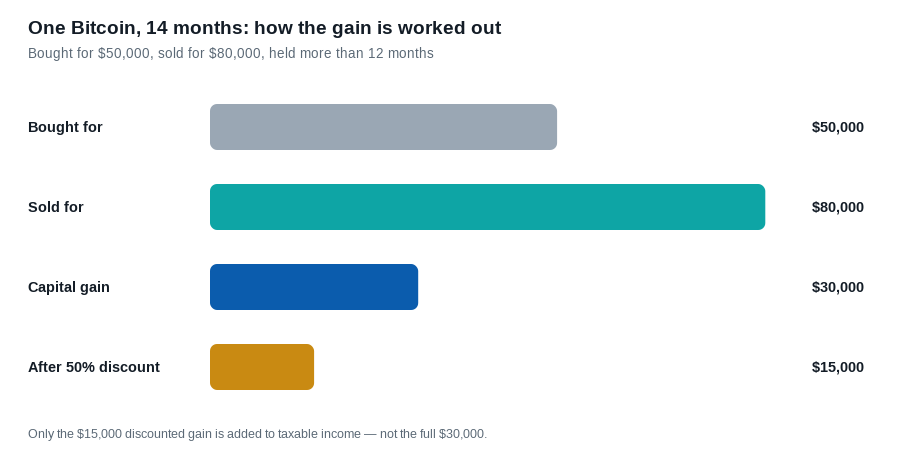
Only the $15,000 discounted gain is added to taxable income — not the full $30,000.
The same gain at different marginal rates
The gain sits on top of your other income, so your marginal tax rate decides the tax bill:
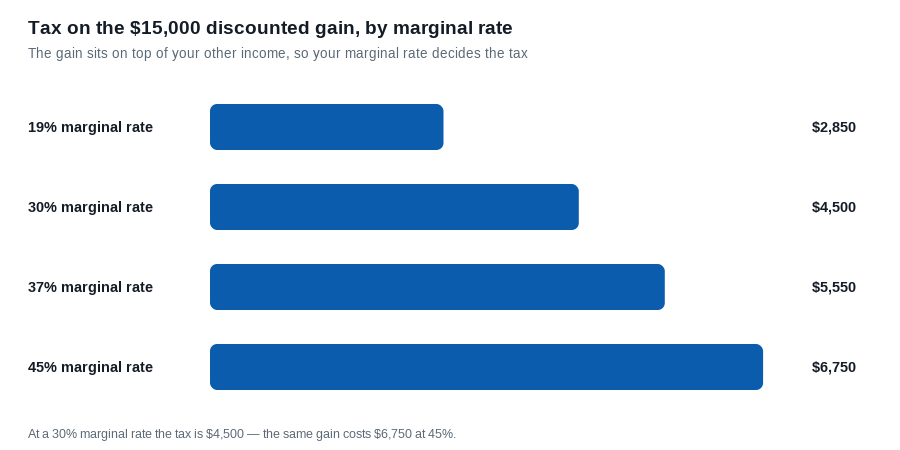
At a 30% marginal rate the tax is $4,500 — the same gain costs $6,750 at 45%.
| Your marginal rate | Tax on the $15,000 discounted gain |
|---|---|
| 19% | $2,850 |
| 30% | $4,500 |
| 37% | $5,550 |
| 45% | $6,750 |
The ATO’s own swap example
The ATO’s worked example shows how a swap is taxed. Usha buys 8,000 PZT for $5,500 and pays $5 brokerage, so her cost base is $5,505. A few days later she exchanges the PZT for 2 CAB, worth $5,600 at the time. Her capital proceeds are $5,600, so her gain is $5,600 − $5,505 = $95 — even though she never saw a dollar.
Months later she swaps the 2 CAB for 0.1 BAT. Her cost base is now $5,600 + $10 brokerage = $5,610, and the BAT is worth $7,000, so her gain on that swap is $7,000 − $5,610 = $1,390. She is not eligible for a discount on either gain, because she held each asset for less than 12 months.
The 50% CGT discount — and what changes in 2027
If you hold a crypto asset for 12 months or more before disposing of it, you can generally halve the capital gain. That is the single biggest lever in crypto tax: in the Bitcoin example above, the discount turns a $30,000 gain into $15,000 of taxable income.
But the discount does not last forever. From 1 July 2027, the 50% CGT discount is replaced by cost base indexation plus a 30% minimum tax on gains. Gains built up before 1 July 2027 keep the old discount treatment. See our guide to CGT changes in 2027 for the full picture — if you are sitting on a large unrealised gain, the timing of a sale matters more than it used to.
Staking rewards and airdrops are ordinary income
Not everything in crypto is a capital gain. If you earn rewards for staking your crypto, the value of those rewards is ordinary income — declare it at “Other income” on your tax return, converted to Australian dollars at the time you receive it.
The same applies to airdrops: the money value of established tokens you receive by airdrop is income when you receive it. And when you later sell those tokens, your cost base is the value you already declared as income — so you are not taxed twice on the same value.
A simple example: you receive $2,000 worth of staking rewards during the year. That $2,000 is added to your taxable income as ordinary income, exactly like interest from a bank account. At a 30% marginal rate, the tax is $600.
The personal use asset exception
There is one narrow exception to CGT on crypto. If you buy crypto and use it in a short period of time to buy personal items, it can be a personal use asset — and a capital gain on a personal use asset is exempt if you acquired it for less than $10,000.
The ATO’s example: Nikesh pays $50 a fortnight to acquire crypto and uses it in the same fortnight to buy computer games. Because he acquires and uses it quickly for personal items, it is a personal use asset.
But the exception is narrow. Crypto you buy as an investment stays an investment even if you later spend some of it on personal items. The ATO’s example: Rosa buys crypto intending to sell it later at a better price, then uses some of it to buy household items. Because her intention was investment, the crypto is not a personal use asset, and any gain on disposing of it is not exempt. Buying crypto to hold and hoping it goes up is investing, not shopping.
Capital losses: don’t waste them
If you dispose of crypto for less than it cost you, you have a capital loss. Capital losses can offset capital gains in the same year, or be carried forward to future years — but only if you report them. A loss you never report is a loss you cannot use.
That matters in a down year: a $5,000 loss on one coin can shelter a $5,000 gain on another, so your net capital gain for the year is zero. Make sure the loss is on your return, even in a year when you owe no tax on it.
Records: what the ATO expects you to keep
The ATO data-matches with Australian crypto exchanges, so it already knows a lot about your transactions. Your job is to have the records that back up your return. Keep them for five years.
The ATO data-matches with crypto exchanges — keep your own records so your return agrees with theirs.
For every transaction, keep:
- the date and time
- the amount in Australian dollars at the time of the transaction
- what the transaction was for — buy, sell, swap, gift, spend
- who the other party was — the exchange or wallet address
- exchange receipts and any brokerage or fees paid
- for staking and airdrops, the date and quantity received and the Australian dollar value
Exchanges can close and accounts can be lost, so export your transaction history regularly rather than relying on the exchange to keep it for you.
Where crypto goes on your tax return
| What happened | Where it goes |
|---|---|
| Capital gain | Total current year capital gains and Net capital gains |
| Capital loss | Net capital losses carried forward to later income years |
| Staking rewards or airdrops | Other income |
| Gains over $10,000 with a CGT schedule | Other CGT assets and any other CGT events |
FAQs about crypto tax
Do I pay tax on crypto if I never cash out to Australian dollars?
Yes, if you disposed of it. Swapping one crypto for another, or spending crypto on goods, is a CGT event even though no Australian dollars changed hands. Only holding — or moving crypto between your own wallets — triggers no tax.
How long do I need to hold crypto for the 50% discount?
At least 12 months. Buy on 1 July 2026 and sell on or after 1 July 2027, and the discount applies. Sell a day early and the full gain is taxable.
Are staking rewards taxed the same way as a capital gain?
No. Staking rewards are ordinary income, taxed in full in the year you receive them, at your marginal rate. They do not get the 50% CGT discount. When you later sell the staked tokens, the value you already declared becomes part of your cost base.
I only bought a small amount of crypto to buy things with. Is it taxable?
Possibly not — if you acquired it for less than $10,000 and used it in a short period to buy personal items, it may be a personal use asset and the gain exempt. But crypto bought as an investment stays an investment even if you spend some of it, so most holdings do not qualify.
What if I lost money on crypto?
Report the capital loss. It offsets capital gains in the same year and can be carried forward to later years. Losses cannot offset salary or other ordinary income — only capital gains.
Does the ATO know about my crypto?
The ATO receives data from Australian crypto exchanges under its data-matching program, and it has run crypto as a tax-time focus area. Assume your exchange transactions are visible to the ATO and lodge on that basis.
This post is general information, not tax or financial advice. Figures are from the ATO as at 23 November 2026, for the 2026–27 income year unless stated otherwise. Check the ATO pages below or speak to a registered tax agent for your own circumstances.
Sources: ATO, Tax and crypto asset investments.
Want to check your own pay and tax? Use our free Weekly Tax Calculator or browse the Tax Blog.
Calculate Your Exact Weekly Tax
Enter your pay details and instantly see your PAYG tax, Medicare levy, and take-home pay.
Open the Calculator